Archives
-

ELF and ELT: Facing the Challenges Ahead
Vol. 3 No. Special Issue (2025)Ever since the process of globalisation has turned English into the primary international
language, research into the impact of English as a lingua franca (ELF) on English language
teaching (ELT) has gained momentum. To date, a steadily growing number of academic
publications, applied projects, seminars and international conferences has been focussed on
the controversial role of ELF in second language development, showing that this thriving area
of study is likely to yield interesting results.
Therefore, the main aim of this special issue is to engage in the current scientific debate
on second language teacher education (SLTE) to stimulate an improved understanding of some
of the most relevant, and to some extent unresolved, aspects to take into consideration, like a)
the emergent nature of ELF in the English classroom; b) the transcultural and multilingual
dimension of ELF in web-mediated learning projects; c) ELF deviations from standard norms,
errors, and the assessment of learners’ competencies; d) profiling the ELF-informed teacher of
English.Our distinguished international authors are here to bring their expertise and share the
achievements of their recent work. This should provide the reader with more theoretical insight
into the role of ELF in ELT, and welcome constructive criticism to face a challenging future. As
Johnson and Golombek (2011: 2) suggest: “The responsibility of SLTE then is to present relevant
scientific concepts to teachers but to do so in ways that bring these concepts to bear on
concrete practical activity, connecting them to their everyday knowledge and the goal-directed activity of teaching".(Johnson, Karen E. e Golombek, Paula R. Eds. (2011). Research on Second Language Teacher Education. Nova York e Londres: Routledge).
-
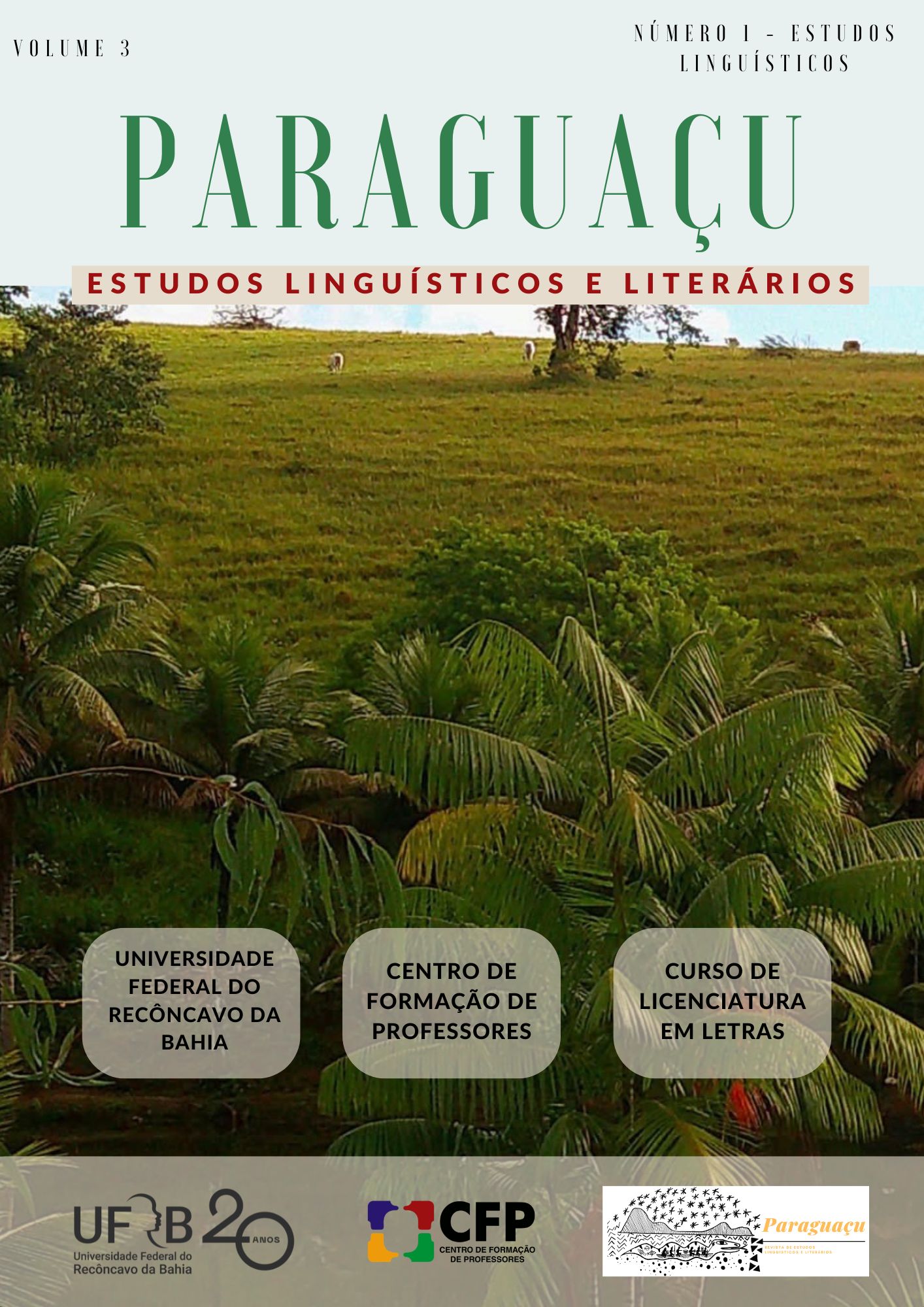
ESTUDOS LINGUÍSTICOS - VOLUME 3
Vol. 3 No. 1 (2025)A Comissão Editorial da Revista Paraguaçu: Estudos Linguísticos e Literários tem a satisfação de apresentar o primeiro número de seu terceiro volume, reafirmando o compromisso da revista com a divulgação de pesquisas que contribuem para o avanço dos estudos da linguagem em suas múltiplas dimensões teóricas, metodológicas e sociais.
Nesta edição, os leitores encontrarão um conjunto diversificado de trabalhos que evidenciam a vitalidade e a pluralidade do campo dos estudos linguísticos. Os textos reunidos abordam questões relacionadas à formação e à inovação lexical, às mudanças e regularidades gramaticais do português, às relações entre linguagem, discurso e práticas sociais, bem como a diferentes manifestações da linguagem em contextos educacionais, literários e digitais.
Os artigos exploram temas que atravessam desde investigações sobre processos morfofonológicos e construções linguísticas emergentes até análises discursivas voltadas à saúde pública, aos processos de ensino e aprendizagem e às políticas e ideologias linguísticas contemporâneas. Também compõem este número reflexões sobre linguagem e literatura, estudos acerca das práticas de escrita em avaliações de larga escala, discussões sobre educação bilíngue, preconceito linguístico e diversidade sociolinguística, além de análises que articulam usos da língua, cultura digital e novas formas de interação mediadas por tecnologias.
O número se encerra com uma resenha que convida os leitores a revisitar discussões fundamentais para os estudos discursivos, ampliando o debate sobre os modos de produção de sentidos e sobre os desafios contemporâneos da análise da linguagem.
A variedade de perspectivas presentes nesta edição reforça nosso entendimento de que a linguagem constitui um fenômeno complexo, cuja compreensão demanda o diálogo entre diferentes tradições de pesquisa e olhares analíticos. Nesse sentido, a Paraguaçu mantém seu propósito de acolher trabalhos que contribuem para ampliar os horizontes de reflexão sobre a língua, o discurso, a literatura e suas interfaces com a vida social.
Agradecemos aos autores, pareceristas ad hoc, membros da Comissão Científica e da Comissão Editorial, cujo trabalho tornou possível a publicação desta edição. Aos leitores, renovamos o convite para navegar pelas águas do Paraguaçu e conhecer pesquisas que, a partir de diferentes perspectivas, contribuem para a compreensão crítica da linguagem e de seu papel na sociedade.
Diogo Oliveira do Espírito Santo
Editor-chefe
Imagem: Parque das Águas - Amargosa
Crédito: Sophia Young -
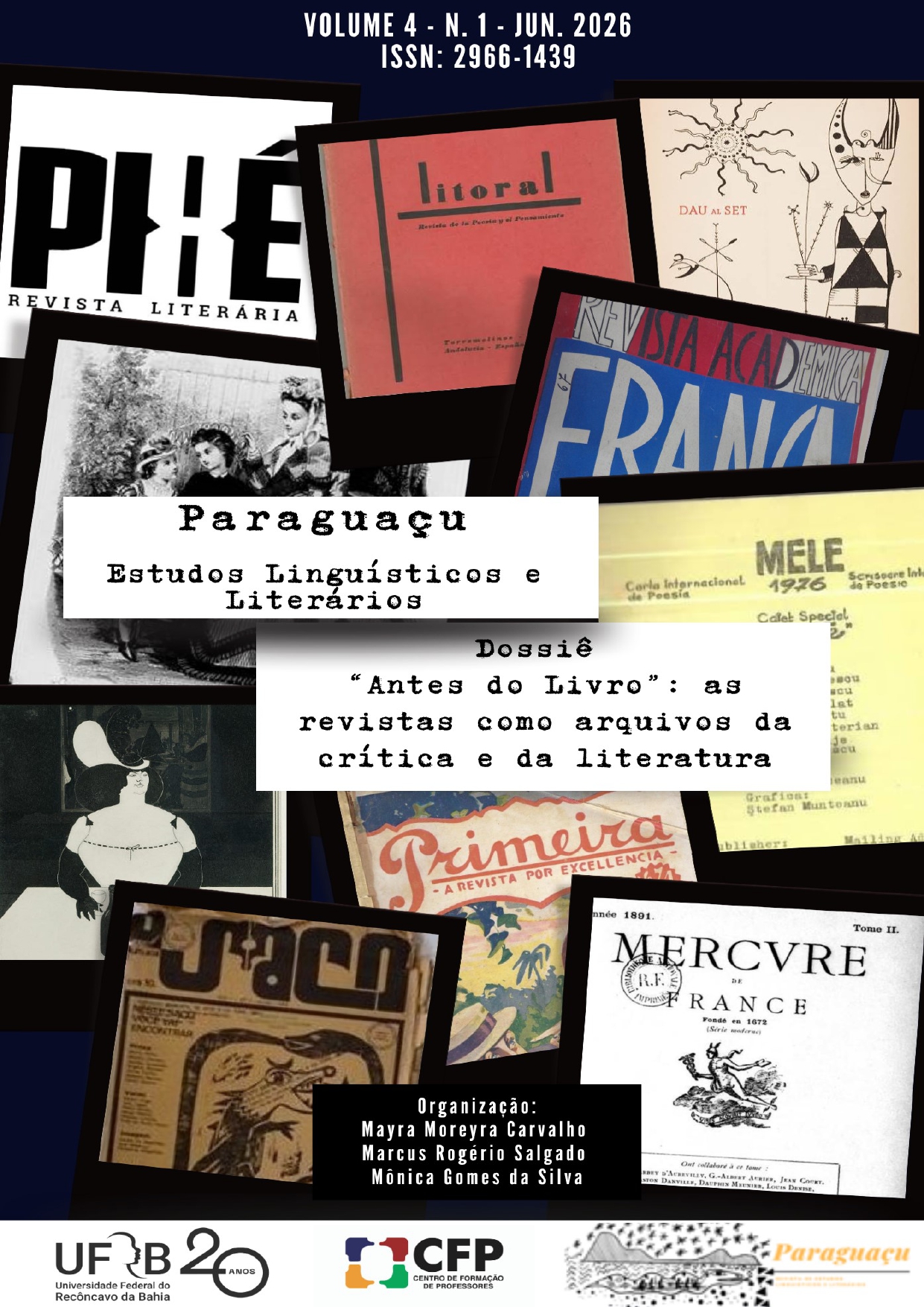
Dossiê “Antes do livro”: as revistas como arquivos da crítica e da literatura
Vol. 4 No. 1 (2026)O dossiê “Antes do livro”: as revistas como arquivos da crítica e da literatura propôs, de certo modo, um exercício metacrítico no âmbito de uma publicação periódica. A chamada, lançada em outubro de 2025, teve como mote a formulação de Roxane Patiño (2009) sobre a especificidade das revistas no contexto latino-americano e a sua importância para a difusão da crítica e da literatura, bem como a articulação de redes intelectuais/artísticas. [...]
Com grande alegria, apresentamos as respostas ao convite, salientando a diversidade, formal e linguística, das publicações analisadas, bem como a inovação dos recortes analíticos destes documentos. Ao todo, os dez artigos que compõem o número se caracterizam pelo olhar intempestivo para publicações que ultrapassam seu contexto imediato e seguem em diálogo com questões atuais. [...] Encerrando o volume, apresentamos a nossa conversa realizada com a Prof.ª Eliane Vasconcellos, pesquisadora titular da Fundação Casa de Rui Barbosa (FCRB).
Ao leitor, desejamos que esta publicação possibilite uma prazerosa visita aos arquivos abertos das revistas estudadas. Boa leitura!
Mayra Moreyra Carvalho
Marcus Rogério Salgado
Mônica Gomes da Silva
OrganizadoresCapa - Mônica Gomes da Silva.
-
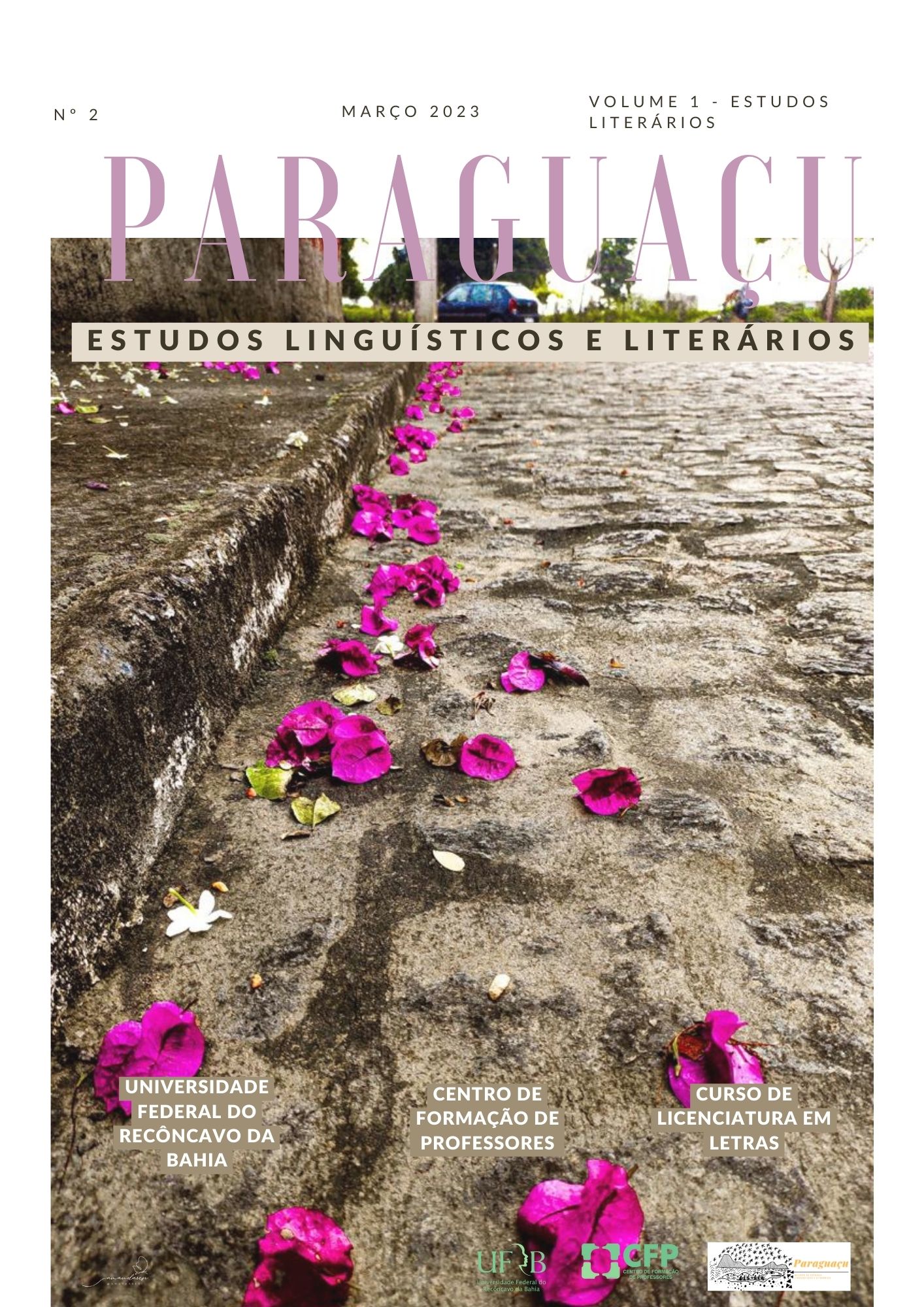
VOLUME 1, NÚMERO 2 - ESTUDOS LITERÁRIOS
Vol. 1 No. 2 (2023)Para que tudo que é produto de esforço coletivo torne-se pronto, há um tempo do trabalho, do esmero, dos detalhamentos individuais, para que se constitua um todo. Nesse tempo, que é dos processos, há atravessamentos variados, dificuldades e, por vezes, perdas, na caminhada de quem trabalha para que as tramas do conjunto sejam firmemente tecidas. E, assim, foi com o segundo número da Revista Paraguaçu: muitas travessias jamais pensadas ou calculadas foram percorridas até que chegassemos a este ponto, aquele em que, orgulhosamente, expomos a nossa revista.
Este é o segundo número do primeiro volume da Revista Paraguaçu: Estudos Linguísticos e Literários, uma produção que visa, sobretudo, a fortalecer e cooperar com o processo identitário do Curso de Letras da Universidade Federal do Recôncavo da Bahia. Neste número, voltamo-nos à publicação de textos no âmbito dos estudos do texto literário.
Iniciamos o número com um importante editorial, em que nossa Editora Adjunta, Prof.ª Dr.ª Silvana Fonseca, situa o processo editorial, bem como as produções publicadas e tece os devidos agradecimentos. Há, em seguida, nove artigos, que percorrem diferentes vertentes da Literatura e de seus estudos. Finalizamos o número com uma uma entrevista inédita com o poeta Cuti acerca da sua obra Axéconchego.
Convidamos-lhes a navegar pela Paraguaçu e desejamos boa leitura a todes!
Amanda dos Reis Silva
Editora-chefe da Revista Paraguaçu
Comissão Editorial da Revista Paraguaçu: Estudos Linguísticos e Literários
-
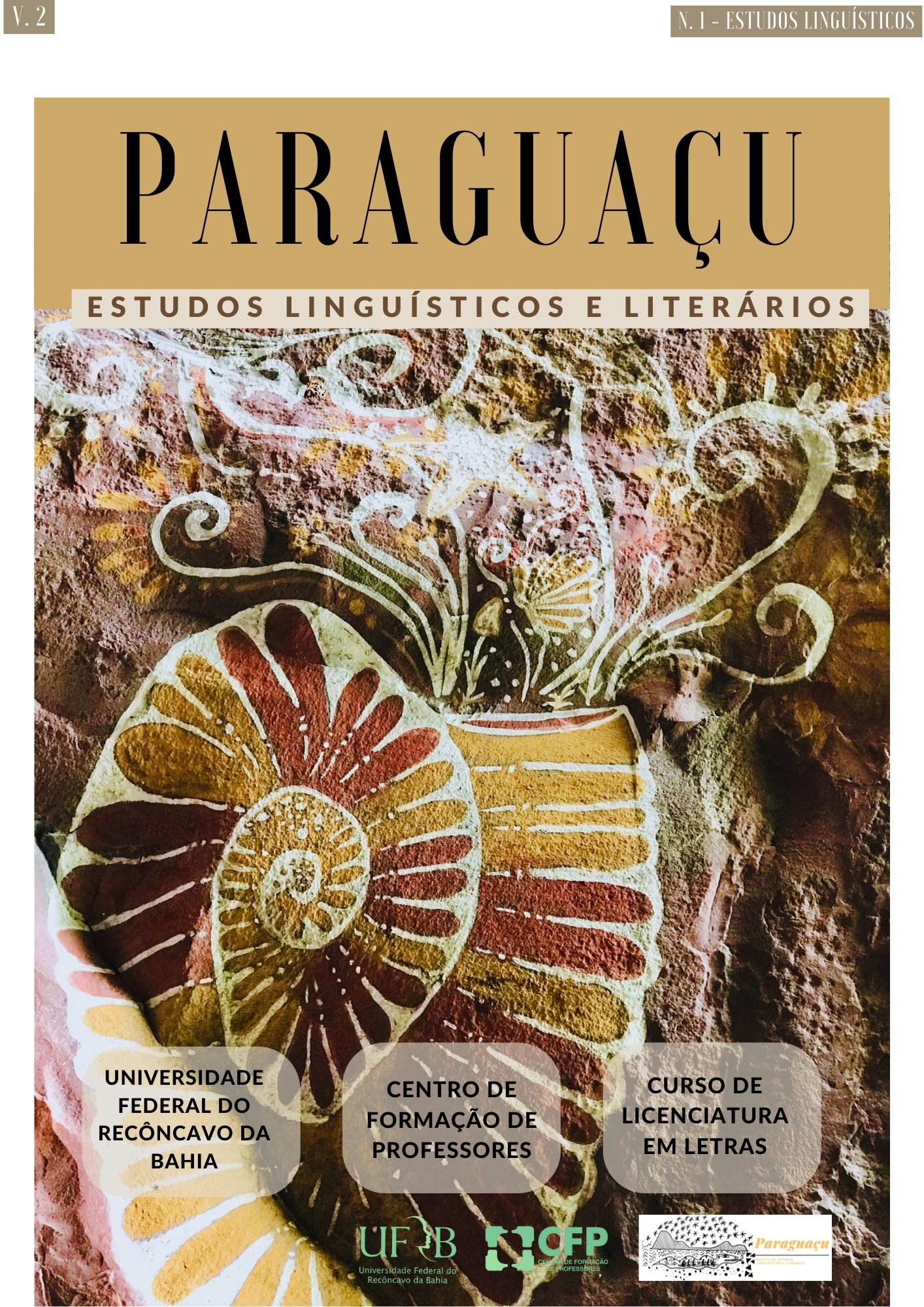
ESTUDOS LINGUÍSTICOS - VOLUME 2
Vol. 2 No. 1 (2024)The Editorial Committee of Revista Paraguaçu: Estudos Linguísticos e Literários is pleased to publish another issue dedicated to Linguistic Studies. After a brief hiatus, which served as an opportunity to renew the team that makes this work possible, the journal returns, now exploring new horizons and possibilities for dialogue and convergence with peers from different universities across the country.
Thus, with texts that address topics of great interest to enthusiasts of linguistic, discursive, and applied studies, you will be introduced to a set of articles that problematize language in its multiple facets. These manuscripts were selected after an intense evaluation process, which involved the collaboration not only of specialists who form our scientific committee but also of ad hoc reviewers who contributed to maintaining the quality of the texts published in our journal.
This time, and after several years since the publication of an issue dedicated to Linguistic Studies and another to Literary Studies, Paraguaçu presents the first part of a new volume, aiming to establish itself as an important tool for disseminating scientific knowledge in the field of Letters. In this sense, you, dear reader, will be taken by the waters of Paraguaçu to studies that explore multiple theoretical-methodological perspectives, including generativism, functionalism, sociolinguistics, discourse analysis, and applied linguistics, reinforcing our understanding that the study of language demands a multitude of voices and viewpoints.
In light of the above, it is with pride in the work accomplished thus far that the Editorial Team of Revista Paraguaçu invites you to dive into the reading of the texts in this issue, hoping that this immersion will keep alive our desire to study, discuss, and problematize language, always in flux.
Diogo Oliveira do Espírito Santo
Editor-in-ChiefEditorial Committee
(Image - Illustration in the Garimpeiro's Hut, in Igatu, Bahia)
-
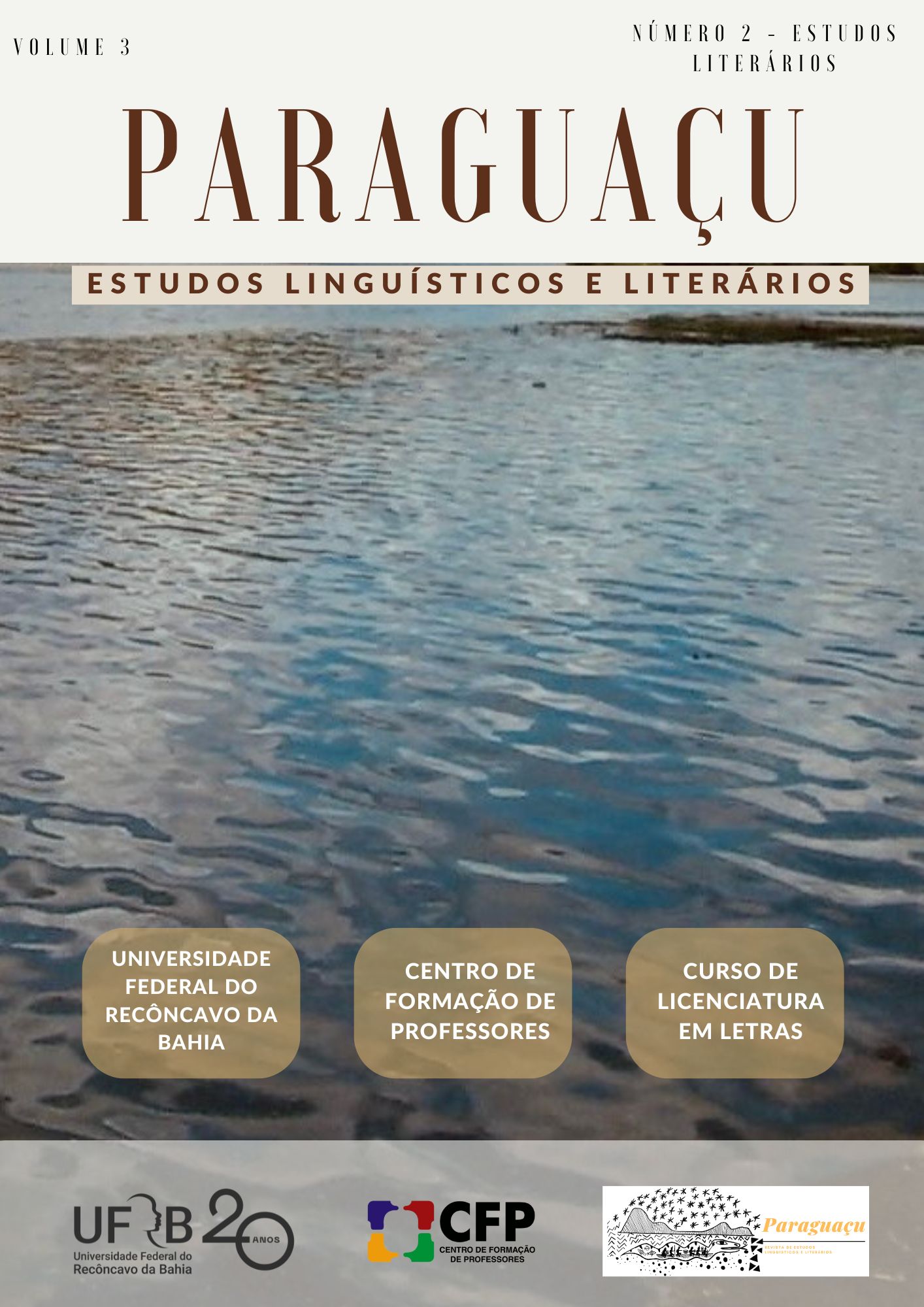
ESTUDOS LITERÁRIOS - VOLUME 3
Vol. 3 No. 2 (2025)É com grande contentamento que a Comissão Editorial da Revista Paraguaçu: Estudos Linguísticos e Literários apresenta, ao público, seu número 2, do volume 3. A chamada de temática livre, lançada em junho de 2025, incluía a recepção de trabalhos dedicados aos estudos literários, o que favoreceu uma ampla e variada abordagem metodológica, teórica e analítica da/na área.
A resposta positiva e expressiva encontra-se neste número, cuja diversidade permite transitar pelas veredas dos atuais estudos de literatura. Os artigos perpassam desde questões teóricas e propostas do campo da tradução, inter-relação com outras artes, representações étnico-raciais e de gênero em obras poéticas e em prosa, discussões sobre pós e decolonialidade, reflexões a partir da memória e do arquivo até os relatos de experiências envolvendo literatura e ensino.
É notável a presença da poesia, seja através da análise de poetas contemporâneos, seja através da (re)leitura de poetas já considerados clássicos. Já as artes como cinema e música permitem expandir o campo do literário. Na prosa, sobressaem os gêneros da chamada “escrita de si” e a labilidade entre memória e ficção, a abordagem de temas como luto e exílio numa realidade instável e cada vez mais fluida e efêmera. Ainda na prosa, além dos contos e romances da nossa literatura, contam-se com obras das literaturas de língua inglesa, italiana, espanhola e africanas de língua portuguesa em que se realiza um comparatismo atualizado em que se busca reinventar centros e margens.
Encerrando o número, são resenhados dois romances lançados, recentemente, por mulheres. Tanto a pernambucana Micheliny Verunschk quanto a inglesa Claire-Louise Bennett realizam, cada qual a seu modo, um habilidoso jogo entre realidade, documento e ficção, cujos limites inconsúteis problematizam e tensionam os modelos miméticos de representação.
O conjunto que ora se apresenta possui, portanto, notáveis pontos de intercessão e se relacionam com a proposta da Paraguaçu no que diz respeito às distintas modalidades de literatura, à interdiscursividade e às questões culturais e identitárias.
Por fim, agradecemos aos autores, pareceristas, membros da Comissão Científica e da Comissão Editorial pela colaboração e o trabalho neste volume. Ao leitor, desejamos que possam levar-se pelo fluxo do rio-linguagem e que os textos presentes nesse número, de alguma forma, contribuam para ampliar os estudos e as pesquisas na área de literatura.
Boas leituras!
Mônica Gomes da Silva
Editora-adjunta
Imagem: Rio Paraguaçu - Cachoeira/BA
Crédito: Mônica Gomes da Silva -

ESTUDOS LINGUÍSTICOS - VOLUME 1
Vol. 1 No. 1 (2021)A Revista Paraguaçu: Estudos Linguísticos e Literários começou a ganhar contornos em novembro de 2019. Tratava-se, em verdade, da renovação de um antigo desejo de docentes do Curso de Licenciatura em Letras da Universidade Federal do Recôncavo da Bahia (UFRB), com o objetivo de lançar ao mundo acadêmico um periódico científico que registrasse, resguardasse e disseminasse a produção de saberes atinentes à(s) língua(s) e à(s) literatura(s), em diversos sentidos e navegações, conforme alude o seu título, ao rio que, em seus fluxos de águas, atravessa o Território de Identidade do Recôncavo Baiano.
Assim, pouco depois, constituiu-se nova Comissão Editorial para o periódico e divulgaram-se chamadas para dois volumes. O primeiro deles deveria ser dedicado aos estudos linguísticos, enquanto o segundo, aos estudos literários. A proposta inicial era de volumes semestrais, para o ano de 2020. As águas de um rio, no entanto, nem sempre correm tranquilas e pacíficas. As navegações da Paraguaçu foram entremeadas por fenômenos novos - pandemia, aulas remotas, sincronicidade, assincronicidade etc. - bem como por passagens entre afluentes, que atingiram os corpos que fazem a revista acontecer (afastamentos, enfermidades, desgastes). Afinal, embora feitos de águas, os rios são contados por gentes e essas, esporadicamente, perecem.
Agora, um ano e alguns meses após a chamada, publicamos nosso primeiro volume, o qual contempla doze artigos inéditos. Neles, percorrem-se caminhos diversificados, navegando-se desde o panorama sonoro do português como L2 a aspectos discursivos de línguas indígenas, perpassando outras temáticas, como o sistema de normas do português e uma proposta de educação linguística antirracista. Oportunamente, agradecemos a esses autores, não somente pela submissão, mas pela disponibilidade em aguardar um tempo não previsto inicialmente.
Registramos agradecimentos, igualmente, aos pareceristas, de diferentes instituições de ensino brasileiras, que navegaram essas águas conosco, lançando olhar crítico e especializado sobre os textos.
Desse modo, orgulhosamente, a Comissão Editorial da Revista Paraguaçu convida a todos à leitura desses artigos e ao diálogo com seus autores, de modo a fomentar novas discussões e manter viva e pulsante a construção científica no âmbito das linguagens.
Amanda dos Reis Silva
Editora-chefe